Consumer Culture
Books
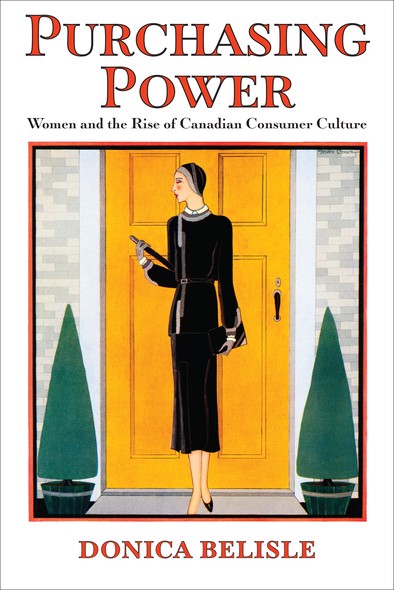
Purchasing Power: Women and the Rise of Canadian Consumer Culture. University of Toronto Press, 2020. Winner of the 2021 City of Regina Book Award.
What Canadians bought, and refused to buy, was a form of political action. Across the twentieth century, manufacturers, retailers, and governments set the prices and terms on which women provisioned their households. Drawing on the records of women’s organizations across the country, this book shows how settler women answered by organizing as consumers, and used their purchasing power for public advocacy and cultural change.
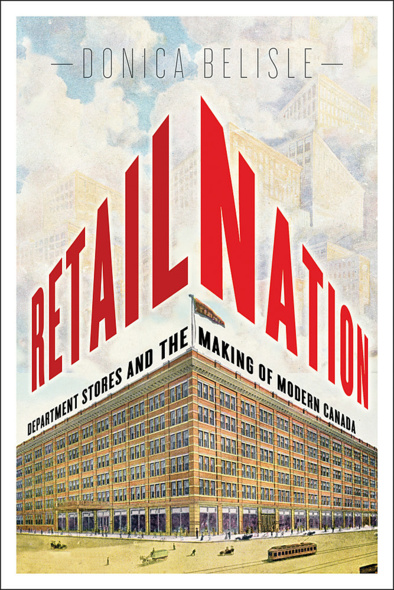
Retail Nation: Department Stores and the Making of Modern Canada. UBC Press, 2011. Pierre Savard Award · Honourable Mention, Sir John A. Macdonald Prize · Shortlisted, John W. Dafoe Book Prize.
Canada’s department stores did more than sell goods. Between 1890 and 1940, Eaton’s, Simpson’s, and the Hudson’s Bay Company sold a vision of what Canada was and should be. Retail Nation examines these institutions as sites of spectacle and desire for shoppers, as workplaces for tens of thousands of Canadians, and as agents of a specific Canadian identity.
Research Articles
-
2014Histoire sociale / Social History 47, no. 93 (2014): 111–38. DOI: 10.1353/his.2014.0002 · [Full text: pending clearance]During and after the First World War, prices rose faster than wages. This article shows how the women who wrote for Woman’s Century answered by pressing manufacturers, retailers, and the state on behalf of Canadian households, even while their overall approach to consumer issues remained conservative.
-
2013“Sexual Spectacles: Women in Canadian Department Store Magazines between 1920 and 1950”In Writing Feminist History: Productive Pasts and New Directions, ed. Catherine Carstairs and Nancy Janovicek, 135–58. Vancouver: UBC Press, 2013. [Full text: pending clearance]Department store staff magazines sexualized their photographs of saleswomen. The stores did this to entertain readers and to sell goods back to their own employees.
-
2011The Canadian Historical Review 92, no. 4 (2011): 581–606. DOI: 10.3138/chr.92.4.581 · [Full text: pending clearance]Winner, Hilda Neatby Article Prize. Department stores in early twentieth-century Canada invented the figure of the irrational female shopper as impulsive, easily manipulated, and susceptible to display. They did this to manage and contain women’s real economic power as the majority of retail customers.
-
2011International Journal of Canadian Studies 43, no. 1 (2011): 165–88. DOI: 10.7202/1009459ar Open AccessEnglish Canadian novelists between 1890 and 1940 wrote about mass consumption as a moral problem. This article asks what their anxieties show about class, gender, and national identity.
-
2007The Journal of Women’s History 19, no. 1 (2007): 58–81. DOI: 10.1353/jowh.2007.0004 · [Full text: pending clearance]Canada’s largest department stores managed their women workers through welfare programs and appeals to loyalty. This article shows how the women accepted, used, and sometimes resisted that paternalism between 1890 and 1960.
-
2006Labour / Le travail 58, no. 2 (2006): 107–44. Open AccessBetween 1890 and 1940 Canada’s largest retailers commodified their own workers alongside the goods they sold. This article shows how the stores did it, and what it meant for the people who worked for them.
-
2005The Canadian Historical Review 86, no. 4 (2005): 641–72. DOI: 10.3138/CHR/86.4.641 · [Full text: pending clearance]Republished in Joan Sangster, ed., “Women’s Voices,” Canadian Historical Review vol. 102, Supplement 3 (2021); and in Home, Work, and Play, 3rd ed. (Oxford University Press, 2015). Between 1948 and 1952, Eaton’s Toronto workers tried to unionize, and failed. This article asks why, and what the answer shows about class, gender, and the limits of postwar consumer prosperity.
-
2003Labour / Le travail 52, no. 2 (2003): 181–206. DOI: 10.2307/25149387 Open AccessThis article argues that Canadian capitalism cannot be understood without its consumers, and sets out how historians might study them.
-
1999Manitoba History 36, no. 2 (1999): 37–40. [Full text: pending clearance]During the Depression, unemployed workers in Brandon, Manitoba published their own newspaper. This article shows how they used it to claim rights as consumers and citizens.
Book Reviews
-
2019Review of Bettina Liverant, Buying Happiness: The Emergence of Consumer Consciousness in English CanadaAmerican Review of Canadian Studies 49, no. 2 (2019): 365–367. [Full text: pending clearance]
-
2016Review of Douglas McCalla, Consumers in the Bush: Shopping in Rural Upper CanadaCanadian Historical Review (2016): 449–452. [Full text: pending clearance]
-
2014Review of Graham Broad, A Small Price to Pay: Consumer Culture on the Canadian Home Front, 1939–45Labour / Le Travail 74, no. 1 (2014): 357–358. [Full text: pending clearance]
-
2012Review of Kate Haulman, The Politics of Fashion in Eighteenth Century AmericaJournal of Consumer Culture (2012): 371–373. DOI: 10.1177/1469540512456935 · [Full text: pending clearance]
-
2006Review Essay: “Suburbanization and Mass Culture in North America”Labour / Le travail 57, no. 1 (2006): 135–44. Open Access
How to Cite
Belisle, Donica. “Consumer Culture.” Donica Belisle. donicabelisle.ca/consumer-culture.html. Accessed