Research
My research documents how Canadian prosperity was built on land and people who were deliberately discounted: sugar refined from colonial plantations in Fiji, department stores that sold a settler vision of modernity, women writers whose work was absorbed into their husbands' reputations. I investigate corporate records, government files, and institutional archives to recover who was written out.
Sugar: Local & Global
Indenture · capitalism · imperialism & colonialism · food studies
Canadian sugar wealth was built on colonial violence, indentured people, and systemic concealment. This research follows the archival paper trail, finding the connections between sugar refining in western Canada and the atrocities inflicted on indentured people from India in colonial Fiji. It examines how the Canadian sugar industry marketed its products by disavowing these global origins, using advertising campaigns that promoted racial purity and erased the people who produced the commodity. This research has to date led to one book and several articles.
Select Publications
-
2024"Violence and Profit: Canada's Debts to the Girmitiyas of Fiji"British Columbia History Magazine (Summer 2024): 22–26. Request copy
-
2023
-
2023The Conversation, 15 March 2023. Republished by Salon and the Vancouver Sun.
-
2021Gastronomica: The Journal for Food Studies 21, no. 2: 14–27
-
2020Global Food History 6, no. 1: 41–59
-
2025Agricultural History 99, no. 1: 102–107
-
2025Review of Sunita Narayan, Across the Kala Pani: Uttar Pradesh to FijiJournal of Pacific History 60, no. 2: 261–2
Hidden Authors
Gender & women's history · intellectual disavowal · academic labour
Academic renown sometimes depends on uncredited labour. During the 1940s and 1950s, faculty wives often typed dissertations, prepared indices, hosted colleagues, curated papers, and brought manuscripts to press, all while raising families and managing households. This project recovers those contributions through the case of Mary Quayle Innis (1899–1972), who was a writer, historian, CBC commentator and more. She was also the wife of Harold Adams Innis, one of Canada's most well known academics. This project examines how her intellectual and caring labour helped build his career and reputation, and why her own accomplishments faded from public view.
Select Publications
-
2018With Kiera Mitchell. The Canadian Historical Review 99, no. 3: 456–86.
- Honourable Mention, Hilda Neatby Article Prize (CHA)
-
2019With Kiera Mitchell. London School of Economics Impact Blog, 18 September 2019. Republished by the World Economic Forum and the LSE Business Review.
-
2013"Guilty Pleasures: Consumer Culture in the Fiction of Mary Quayle Innis"In Consuming Modernity: Changing Gendered Behaviours and Consumerism, 1919–1945, ed. Cheryl Warsh and Dan Malleck, 258–73. Vancouver: UBC Press. Request copy
Consumer Identity & Advocacy
Consumer history · gender & women's history · community organizing · settler politics
Consumers have been a powerful force in Canadian life, yet their political significance has rarely been taken seriously. This research recovers consumers' identities and work. Drawing on the records of the Fédération nationale Saint-Jean-Baptiste, Women's Christian Temperance Union, National Council of Women of Canada, Women's Institutes, and the Canadian Home Economics Association, as well as on published Canadian fiction, it shows that what Canadians bought, and refused to buy, became instruments of political and economic change. Settler women in particular used consumption as a vehicle for artistic creativity and public action. This research culminated in my second book, Purchasing Power (University of Toronto Press, 2020).
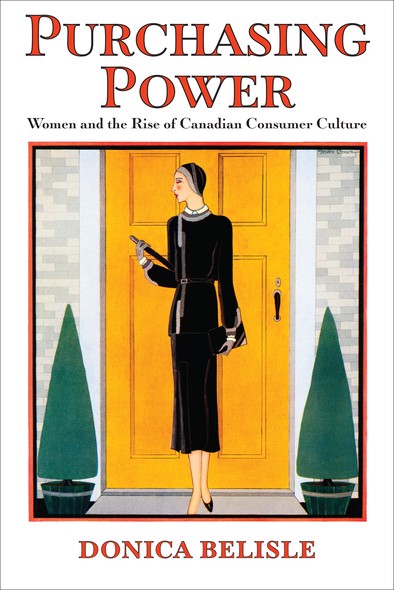
- City of Regina Book Award, 2021
Select Publications
-
2014Histoire sociale / Social History 47, no. 93: 111–38
-
2011The Canadian Historical Review 92, no. 4: 581–606.
- Hilda Neatby Article Prize (CHA)
-
2011International Journal of Canadian Studies 43, no. 1: 165–88
-
2003Labour / Le travail 52, no. 2: 181–206
Mass Retail & Canadian Nationhood
Retail history · settler nationalism · labour commodification · gender & women's history
Canada's major department stores, including Eaton's, Simpson's, and the Hudson's Bay Company, did more than sell goods between 1890 and 1940. They sold a vision of modern Canada that was white, acquisitive, and British. This research draws on store records, advertising archives, labour records, and consumer correspondence to show how mass retail built settler national identity while commodifying the workers who made it possible. This research culminated in Retail Nation (UBC Press, 2011) and several other publications.
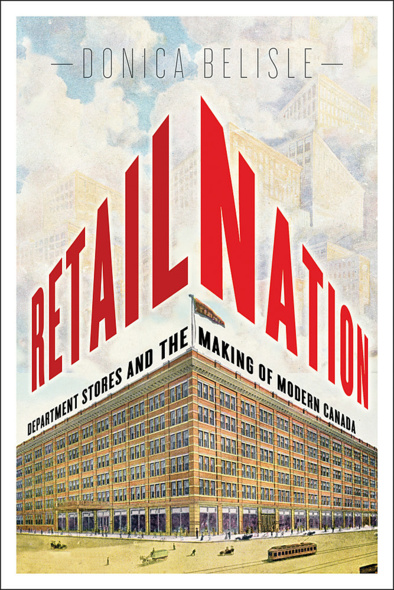
- Pierre Savard Award (ICCS)
- Best Book in Canadian Studies (CSN)
- Honourable Mention, Sir John A. Macdonald Prize (CHA)
- Shortlisted, John W. Dafoe Book Prize
Select Publications
-
2020Active History, 8 July 2020.
-
2013"Sexual Spectacles: Women in Canadian Department Store Magazines between 1920 and 1950"In Writing Feminist History: Productive Pasts and New Directions, ed. Catherine Carstairs and Nancy Janovicek, 135–58. Vancouver: UBC Press. Request copy
-
2007The Journal of Women's History 19, no. 1: 58–81
-
2005The Canadian Historical Review 86, no. 4: 641–72
-
2006Labour / Le travail 58, no. 2: 107–44