
The Stores That Built Canada
October 2026
Revised and condensed by the author, October 2026, from an essay first published in Active History, 8 July 2020.
The Hudson’s Bay Company is gone. In 2025, after 355 years of continuous operation, Canada’s oldest company filed for creditor protection. It laid off its employees and closed its stores; many of the buildings now sit empty.
Six years ago, I took stock of the Bay’s department stores’ roles in Canadian history. The Bay entered the urban retail game late, in 1913, after Eaton’s and Simpson’s had already established their grips. Yet the Bay soon became Canada’s third largest retailer. It expanded throughout the 20th century, including by buying two of its competitors, Simpson’s and Morgan’s.
In this essay, I reflect on the Bay’s retail division. In addition to joining Eaton’s and Simpson’s in spreading settler culture, the Bay also promoted norms of colonial exclusion. Equating Euro-Canadian presence with modernity, the Hudson’s Bay Company’s print materials centred Euro-Canadians as architects and beneficiaries of the modern Canadian nation.
Note: Researchers continue to document the Hudson’s Bay Company’s history. This brief entry is part of that broader project.
Originally published in Active History, 8 July 2020. Condensed and revised, October 2026.
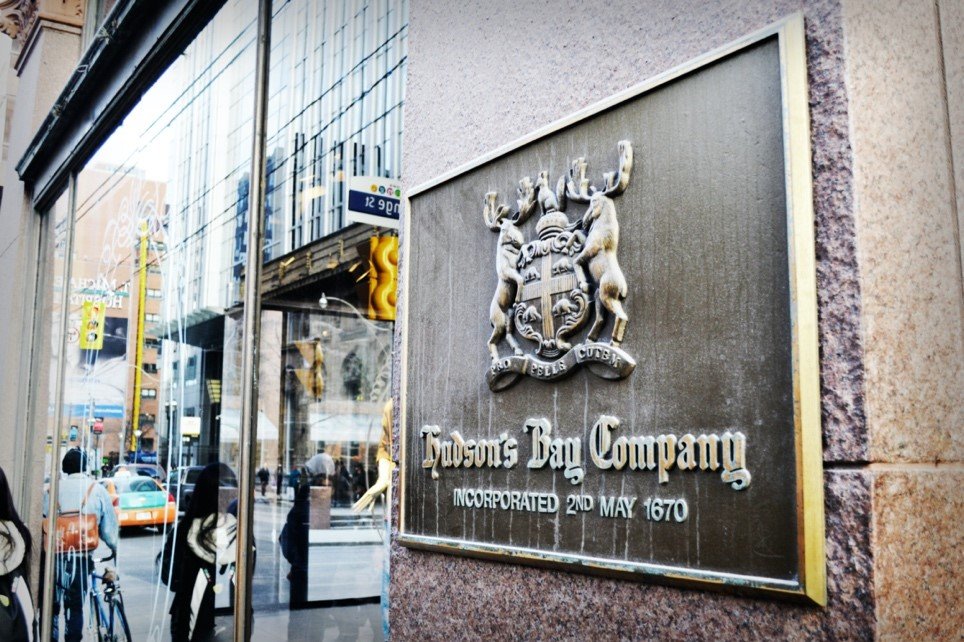
This year [2020] marks the 350th anniversary of the Hudson’s Bay Company. Surprisingly, “the Bay” – as the famous department store is now known – is being fairly quiet about it. Apart from launching a few specially-themed blankets, and partnering with a few companies for some new products, the firm is keeping a low profile. Perhaps this discretion is due to COVID-19. Given the ravages the disease has brought, it seems untimely to celebrate an anniversary.
Yet other forces are also at play. As Andrew Smith and Daniel Simeone note, the Bay treads cautiously in its treatment of its past. Whereas earlier anniversaries – including the 250th one, celebrated in 1920 – were marked with fanfare, the Bay is today more careful about its long history. Incorporated in 1670 and given a charter by the King of England to develop an exclusive trading monopoly with Indigenous nations in the Hudson’s Bay watershed, this company once claimed sovereignty over 40 per cent of the area now known as Canada. In 1869 it sold that unceded land to the Dominion of Canada. Separating itself into three divisions (fur, land, and retail), it next established a string of department stores.
In this essay, the Bay’s retail division is considered. For the first half of the 20th century, not only the Bay but such other major retailers as Eaton’s and Simpson’s were involved in colonizing northwestern North America. By remembering this history, we can see that major Canadian retail has facilitated colonial dispossession.
Retail Empires
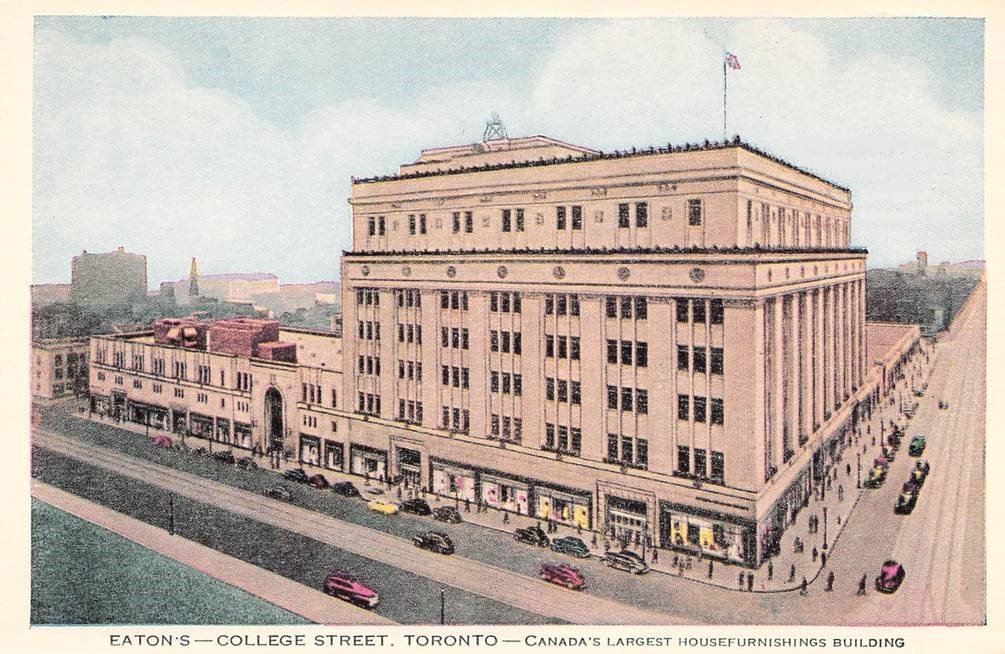
The Bay might be the oldest company in Canada, but it is Eaton’s that became Canada’s largest retailer. Established in 1869 in Toronto, by the 1910s this company had become the largest store in the British Empire and the eighth largest retailer in the world. Second only to the US company Sears in sales, Eaton’s achieved its size by capitalizing on the Canadian government’s decision to colonize the northwest. Eaton’s was a chain of department stores that also had a mail order empire whose products reached across the continent.
Eaton’s profited from the federal government’s National Policy. Introduced by the Conservatives in 1878, the Policy was a program for growth that entailed three strategies: settlement, railways, and tariffs. These initiatives were intended to boost manufacturing, turn the western interior into an agricultural powerhouse, increase settlement, and open up further trade. Racialized violence in the west – a process that James Daschuk calls “Clearing the Plains” – was central to this initiative. In 1871 Canada had started a treaty signing initiative with western Indigenous nations; this process lasted until 1921 by which time eleven treaties were signed. People who refused government demands were treated severely. In 1885 the federal government went to war against the Métis in Saskatchewan, refusing to recognize their sovereignty. After the Battle of Batoche, it hanged eight Indigenous men who had allegedly killed settlers; it also hanged Métis leader Louis Riel, charging him with treason. Simultaneously, it forcibly moved over 5,000 Indigenous people to reserves, an act that included withholding food until people surrendered. Canada further authorized the move west of approximately two million people, including both immigrants and Canadians, between the years 1891 and 1921. Due to racialized policies, most western settlers were of European descent.
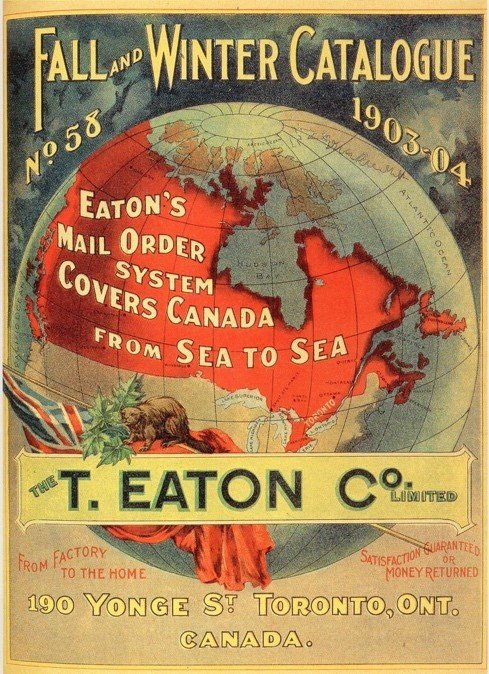
Seizing the opportunity that this growth represented, in the 1880s Timothy Eaton began a small catalogue business. By 1895, his catalogues were reaching the outermost homes of the nation. Some said they were more plentiful than the Bible. Given away freely twice a year, the catalogues – together with those distributed by another Toronto department store, Simpson’s – provided hours of entertainment. They also served, famously, as reading material and toilet paper in outhouses. Toronto’s largest department stores thus brought mass consumer culture to millions. Due to the miracles of industrialization and transportation, they claimed, department stores made goods available to all. As Simpson’s said in 1896, “Millions in merchandise. Cheapness unmeasured. They bring happiness.”
In 1905, Eaton’s opened a branch store in Winnipeg. With 1,250 employees, it was the first major department store in western Canada. According to Eaton’s, this move was a triumph of civilization. In choosing this location, Eaton’s had built some distance away from the Bay’s location at Fort Garry. Through this move, it channeled shopping away from Fort Garry and toward its own neighbourhood.
Eaton’s publicists, in turn, portrayed this shift as a triumphant erasure of fur trade life. According to the company’s own historian in 1919, Eaton’s store lured “retail traffic” away from historic Fort Garry, which had previously been the starting point of the “old [Indigenous] trail to the far West.” A window display played up this theme. Eaton’s 1919 history book noted that it offered “a Pageant of Western Progress, showing [Indigenous people], trappers, pioneer settlers, etc., etc., in their respective relations to the growth of the Prairie provinces.”
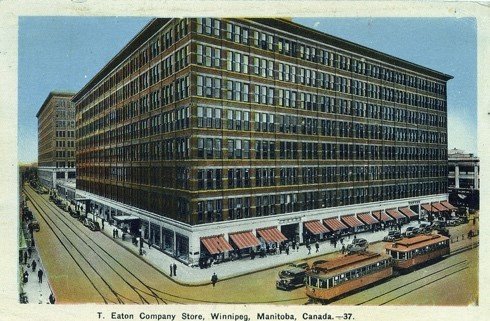
The Hudson’s Bay Company watched as Eaton’s expanded. In 1890, the Bay had built a two-storey store in Calgary. Soon afterward, it built stores in Vancouver and Edmonton. But it was the arrival of Eaton’s in Winnipeg in 1905 that encouraged it to move more aggressively. In 1911, the Bay opened a new department store in Winnipeg.
In March 1921 the Bay’s magazine, The Beaver, published an article called “From Pioneer Trading Post to Great Department Store” by Edmonton advertising manager Jack Prest. According to Prest, the Bay had always been a settler haven. After it was built in 1798, Fort Edmonton had, in Prest’s word, pacified those who lived there. During the 1885 Resistance, it became “a refuge” for fearful settlers. A few years later, the store became a panoply of “past” and “present,” represented first by Indigenous customers going about “gaily bedecked and painted” and second by “townspeople” “[w]ell-dressed … in the season’s latest fashions.” As more Euro-Canadians arrived, the former “customs gradually died out.” By 1921, Edmonton’s HBC was “a thoroughly modern department store worthy of the largest eastern cities.”
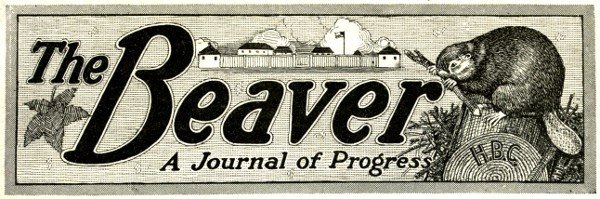
The Bay’s publications sometimes carried racist material. In 1922, The Beaver included an article titled “English as She Is Wrote.” It featured “[a]n order written by an [Indigenous person] and received by an H.B.C. Post” and made fun of the order’s unconventional spellings. The Beaver also printed offensive jokes about Black people, as it did in 1926. Other instances of racism occurred both in person and in print at the stores, as I document in my book, Retail Nation.
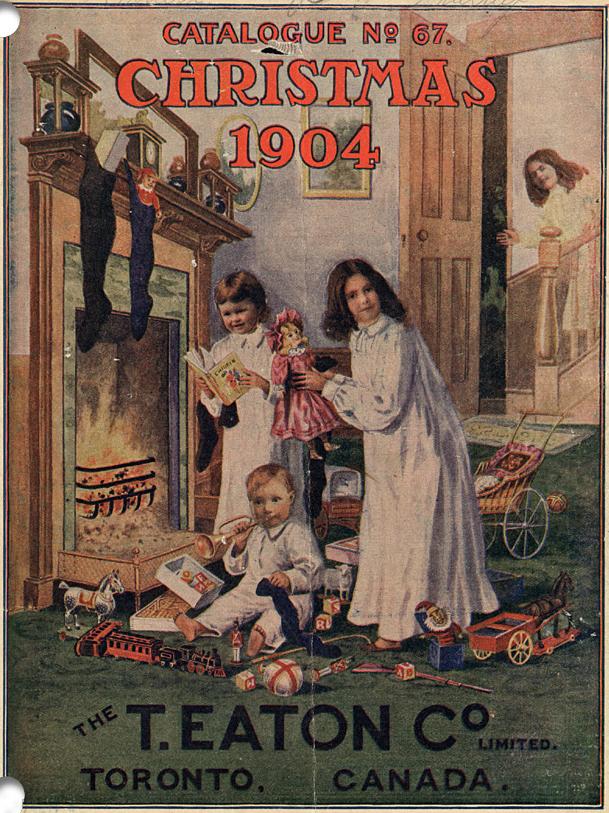
During the first half of the 20th century, Canadian department stores were among the largest advertisers in the country. This publicity varied, but consistent throughout was the notion that Euro-Canadians were ideal consumers. From the early 1900s until the 1950s and beyond, Eaton’s catalogues typically only depicted people of European descent, such as on Eaton’s 1904 Christmas catalogue cover.
Department Stores and Colonialism
Between 1670 and 1869, the Hudson’s Bay Company was an imperial power. After 1869, the Canadian state began its own colonial program. As more settlers moved into the west, department stores, including the Bay’s, emerged. By the 1910s, Eaton’s in particular had parlayed its profits from western expansion into massive success, becoming the second largest retailer in North America.
As we reflect on the Bay’s past 350 years, it is clear that its fur, land, and retail divisions have all been influential. By directing attention to the history of the Bay’s department stores, we can see that its retail branch furthered its colonial mission.
Publication note
Revised and condensed by the author, October 2026, from an essay first published as “On the Bay’s 350th, let’s remember department stores’ contributions to colonialism and white supremacy,” Active History, 8 July 2020. The original essay remains available at Active History.
This article draws on research from Retail Nation: Department Stores and the Making of Modern Canada (UBC Press, 2011).
People, profit, and the making of modern Canada.
Subscribe by email