Retail and Department Stores
The Hudson’s Bay Company is gone. Eaton’s closed in 1999. The consumer culture these retailers built, and the colonial order they sustained, outlasted them. This research follows the history of Canadian mass retail and consumer culture from the department store era to the present. It asks who built the stores, what the working and shopping conditions were like, and how people responded to those conditions. Research on consumers and consumer culture is in Women and Consumer Culture. See also Essays.
Book
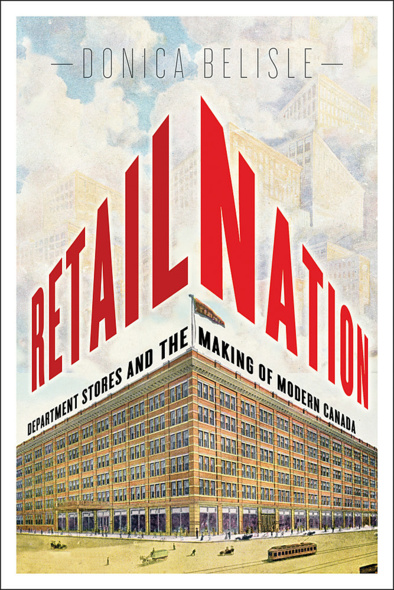
Retail Nation: Department Stores and the Making of Modern Canada. UBC Press, 2011. Pierre Savard Award · Best Book in Canadian Studies · Honourable Mention, Sir John A. Macdonald Prize · Shortlisted, John W. Dafoe Book Prize.
Canada’s department stores did more than sell goods. Between 1890 and 1940, Eaton’s, Simpson’s, and the Hudson’s Bay Company sold a vision of what Canada was and should be. Retail Nation examines these institutions as sites of spectacle and desire for shoppers, as workplaces for tens of thousands of Canadians, and as agents of a specific Canadian identity.
Research Articles
-
2013In Feminist History in Canada: New Essays on Women, Gender, Work, and Nation, ed. Catherine Carstairs and Nancy Janovicek, 135–58. Vancouver: UBC Press, 2013. Full text (PDF)Department store staff magazines sexualized their photographs of saleswomen. The stores did this to entertain readers and to sell goods back to their own employees.
-
2011The Canadian Historical Review 92, no. 4 (2011): 581–606. DOI: 10.3138/chr.92.4.581 · [Full text: pending clearance]Winner, Hilda Neatby Article Prize. Department stores in early twentieth-century Canada invented the figure of the irrational female shopper as impulsive, easily manipulated, and susceptible to display. They did this to manage and contain women’s real economic power as the majority of retail customers.
-
2007The Journal of Women’s History 19, no. 1 (2007): 58–81. DOI: 10.1353/jowh.2007.0004 · [Full text: pending clearance]Canada’s largest department stores managed their women workers through welfare programs and appeals to loyalty. This article shows how the women accepted, used, and sometimes resisted that paternalism between 1890 and 1960.
-
2006Labour / Le travail 58, no. 2 (2006): 107–44. Open AccessBetween 1890 and 1940 Canada’s largest retailers commodified their own workers alongside the goods they sold. This article shows how the stores did it, and what it meant for the people who worked for them.
-
2005The Canadian Historical Review 86, no. 4 (2005): 641–72. DOI: 10.3138/CHR/86.4.641 · [Full text: pending clearance]Republished in Joan Sangster, ed., “Women’s Voices,” Canadian Historical Review vol. 102, Supplement 3 (2021); and in Home, Work, and Play, 3rd ed. (Oxford University Press, 2015). Between 1948 and 1952, Eaton’s Toronto workers tried to unionize, and failed. This article asks why, and what the answer shows about class, gender, and the limits of postwar consumer prosperity.
Essay
-
2020Originally published in Active History, July 2020. Revised and condensed, October 2026. Open AccessAs their own records reveal, the Hudson’s Bay Company and Eaton’s were not only retailers. They were also instruments of colonization.
How to Cite
Belisle, Donica. “Retail and Department Stores.” Donica Belisle. donicabelisle.ca/retail.html. Accessed